FLOW asked a specific clinical question: could once-weekly injected semaglutide reduce serious kidney-related outcomes in people who already had both type 2 diabetes and chronic kidney disease? Its answer was favorable, but the result is not a universal claim about kidney protection for everyone using a weight-management medicine. The trial enrolled people with defined levels of reduced kidney filtration and albumin in their urine, followed them for a median of 3.4 years, and counted an outcome that included cardiovascular death as well as kidney events.
The most useful reading separates several findings: fewer first events in the primary composite, a favorable kidney-specific composite, slower average loss of estimated kidney function, and fewer deaths. These findings reinforce one another without being interchangeable. This analysis uses the indexed primary report abstracts for FLOW and SELECT, together with available official patient and regulatory material; it does not represent a review of all trial protocols, supplements, or full texts. The aim is to explain what the reported numbers support, what remains unresolved, and which questions belong in an informed clinical discussion.
At a glance
- Population and comparison
- FLOW randomized 3,533 adults with type 2 diabetes and defined chronic kidney disease to weekly subcutaneous semaglutide 1.0 mg or placebo.Sources: [1]
- Primary outcome
- There were 331 first primary-outcome events with semaglutide and 410 with placebo: hazard ratio 0.76, 95% confidence interval 0.66–0.88.Sources: [1]
- Kidney-specific result
- The composite limited to kidney-specific components also favored semaglutide: hazard ratio 0.79, 95% confidence interval 0.66–0.94.Sources: [1]
- Kidney-function trajectory
- Mean annual eGFR decline was slower by 1.16 mL/min/1.73 m² in the semaglutide group; this is a difference in average slope, not a kidney-failure event count.Sources: [1]
- Follow-up and safety
- Median follow-up was 3.4 years after recommended early cessation at a prespecified interim analysis. Serious adverse events occurred in 49.6% versus 53.8% of participants.Sources: [1]
FLOW studied established kidney disease, not a general weight-loss population
FLOW’s 3,533 randomized participants all had type 2 diabetes and chronic kidney disease meeting specified laboratory thresholds. The semaglutide group included 1,767 people, and the placebo group included 1,766. The intervention was a 1.0-mg subcutaneous injection once weekly. Those details identify the experimental arm; they are not instructions for starting or adjusting treatment.
Random assignment makes the comparison more informative than simply observing people who chose to take a medicine. It is designed to distribute measured and unmeasured differences between groups rather than let treatment selection determine the comparison. Placebo supplied the reference against which the reported event rates and kidney-function changes were evaluated.
The central applicability question is therefore not just whether someone uses semaglutide. It is whether their diabetes status, kidney disease, and treatment context resemble those studied. The indexed abstract does not provide a full breakdown of background medicines, demographics, adherence, or treatment changes. Those omissions limit how precisely this abstract-based analysis can describe who most closely matches the trial.
Two laboratory measurements defined entry into the trial
Estimated glomerular filtration rate, or eGFR, estimates how much blood the kidneys filter. It is expressed in milliliters per minute standardized to 1.73 square meters of body-surface area. Urinary albumin-to-creatinine ratio, or UACR, measures albumin in urine relative to creatinine. These tests describe different dimensions: filtration capacity and leakage of a protein that ordinarily remains largely in the blood.
FLOW paired these measurements rather than accepting any diagnosis of kidney disease. Participants with eGFR from 50 through 75 needed UACR above 300 and below 5,000 mg/g. Those with eGFR from 25 to below 50 needed UACR above 100 and below 5,000 mg/g. The strict greater-than and less-than boundaries matter when describing the studied population.
Interpretation: this design selected people with substantial kidney risk, including albuminuria, rather than everyone with a slightly abnormal kidney test. It does not directly establish the same benefit in people with normal filtration, little or no albuminuria, no diabetes, or kidney function outside these ranges. A laboratory value can help assess resemblance to the study without, by itself, determining an individual treatment decision.
| Entry group | eGFR, mL/min/1.73 m² | UACR, mg/g |
|---|---|---|
| Higher filtration range | 50 to 75 | Greater than 300 and less than 5,000 |
| Lower filtration range | 25 to less than 50 | Greater than 100 and less than 5,000 |
STUDY DATA · GLP-1 Care Insight
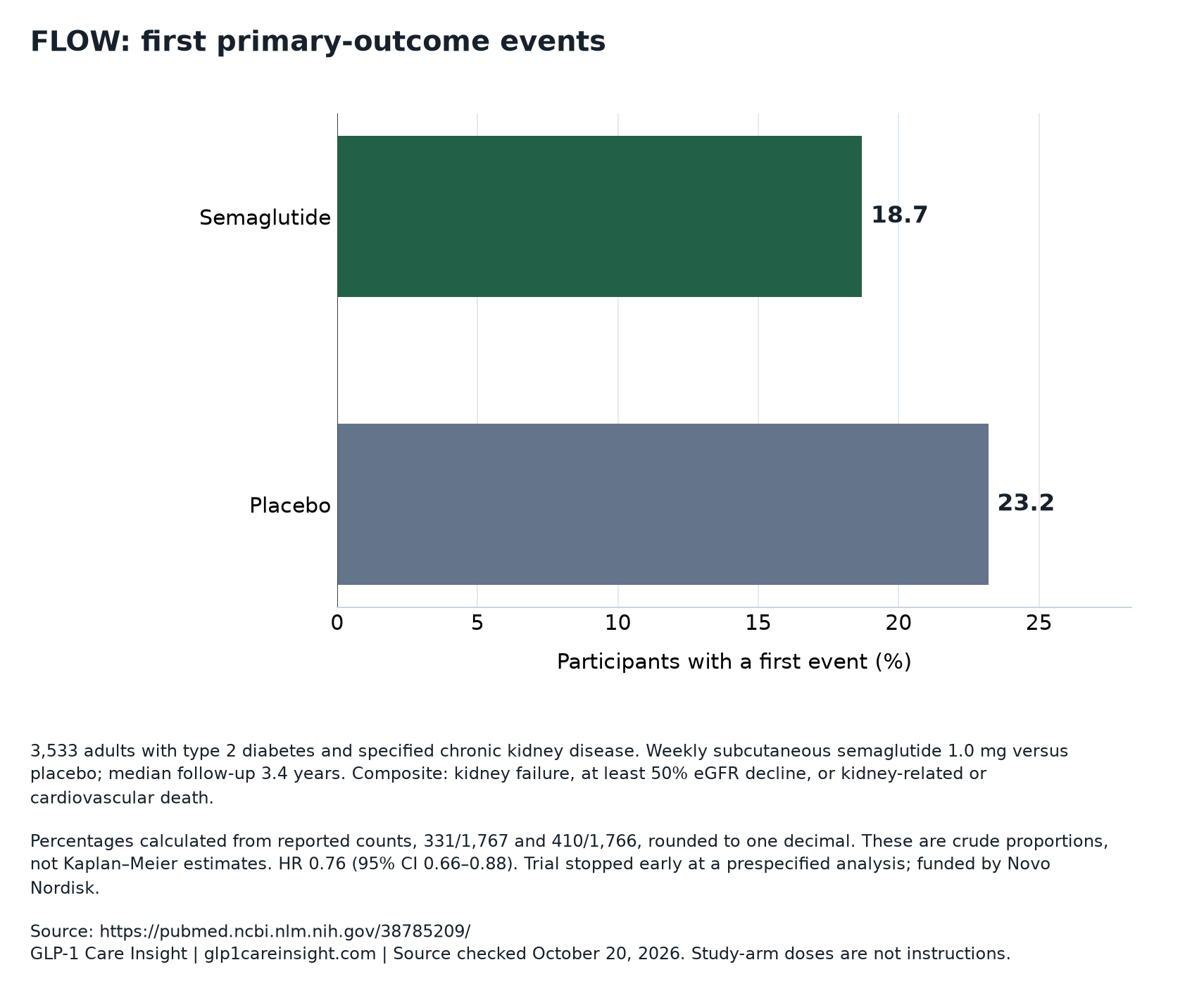
FLOW: first primary-outcome events
3,533 adults with type 2 diabetes and specified chronic kidney disease. Weekly subcutaneous semaglutide 1.0 mg versus placebo; median follow-up 3.4 years. Composite: kidney failure, at least 50% eGFR decline, or kidney-related or cardiovascular death.
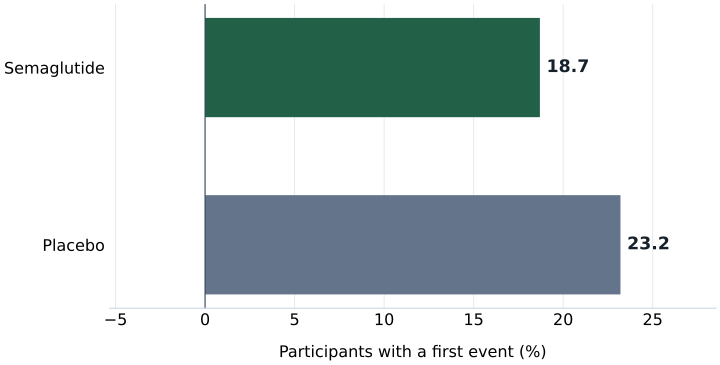
| Study group | Participants with a first event (%) |
|---|---|
| Semaglutide | 18.7 |
| Placebo | 23.2 |
Percentages calculated from reported counts, 331/1,767 and 410/1,766, rounded to one decimal. These are crude proportions, not Kaplan–Meier estimates. HR 0.76 (95% CI 0.66–0.88). Trial stopped early at a prespecified analysis; funded by Novo Nordisk.
Original visualization of published aggregate data. No individual prediction or provider performance is represented. Original research ↗
The primary endpoint included cardiovascular death
The primary outcome combined kidney failure, a reduction of at least 50% in eGFR from baseline, and death from kidney-related or cardiovascular causes. Kidney failure itself could mean dialysis, transplantation, or eGFR below 15 mL/min/1.73 m². Thus, an event did not have to be dialysis to count, and not every event represented the same clinical experience.
A composite endpoint gathers several outcomes into one analysis. That can capture a broader burden of disease, but it also means the headline result must be read alongside its components. Cardiovascular death was part of FLOW’s main endpoint, not merely an unrelated observation reported afterward.
A lower composite hazard does not prove that each component fell by the same amount—or that every component individually showed a clear difference. The abstract provides a kidney-specific composite and cardiovascular-death estimate, but not separate estimates for dialysis, transplantation, and each remaining component. The same reading discipline is useful when approaching the SUMMIT heart-failure composite analysis: identify what gets counted before interpreting a single summary percentage.
Reading the 24% result without turning it into a 24-point reduction
FLOW recorded 331 first primary-outcome events among 1,767 semaglutide participants and 410 among 1,766 placebo participants. The primary time-to-event analysis produced a hazard ratio of 0.76, with a 95% confidence interval from 0.66 to 0.88. The report described this as a 24% lower risk. More precisely, the estimate concerns the relative hazard of a first event over follow-up.
As a descriptive calculation, the counts divided by the randomized group sizes are approximately 18.7% and 23.2%, a difference of about 4.5 percentage points. That arithmetic helps show why a 24% relative reduction is not a 24-percentage-point reduction. However, these crude proportions do not reproduce the time-to-event analysis, which incorporates when events occur and follow-up information.
The confidence interval expresses uncertainty around the hazard-ratio estimate: it is compatible with relative hazard reductions of roughly 12% to 34%. It does not describe the range of benefit every patient will experience. The reported primary P value was 0.0003. Neither that value nor the confidence interval supplies an individual forecast or establishes what the absolute difference would be over a different treatment period.
Kidney-specific events and filtration slope answer different questions
When the investigators examined a composite containing only the kidney-specific parts of the primary outcome, the hazard ratio was 0.79, with a 95% confidence interval of 0.66 to 0.94. This matters because the main result could otherwise leave readers wondering whether it reflected cardiovascular death alone. The kidney-specific composite also favored semaglutide, although it still combined multiple kidney outcomes.
A separate analysis examined eGFR slope: the average annual rate of change in estimated filtration. The decline was less steep with semaglutide by 1.16 mL/min/1.73 m² per year, with P<0.001. This is a between-group difference in average trajectory. It does not mean that everyone gained that amount of kidney function or that all decline stopped.
Nor can the slope difference be converted directly into a number of years until dialysis. Doing so would require assumptions about starting kidney function, whether the trajectory remains linear, future treatment, and competing events such as death. The abstract does not report the two groups’ actual slope values or a confidence interval for their difference. The defensible conclusion is slower average decline, alongside favorable clinical-event evidence—not a personalized kidney countdown.
The secondary findings broadened the result without explaining its mechanism
FLOW prespecified confirmatory secondary outcomes and tested them hierarchically. Hierarchical testing uses an ordered sequence to address the statistical problem created by testing multiple outcomes. It distinguishes planned confirmatory questions from an unrestricted search for favorable findings. The indexed abstract reports that all confirmatory secondary outcomes favored semaglutide.
Alongside the eGFR-slope result, major cardiovascular events had a hazard ratio of 0.82, with a 95% confidence interval of 0.68 to 0.98, and death from any cause had a hazard ratio of 0.80, with a confidence interval of 0.67 to 0.95. The corresponding reported P values were 0.029 and 0.01. Cardiovascular death, also part of the primary composite, had a hazard ratio of 0.71, with a confidence interval of 0.56 to 0.89.
These estimates describe different endpoints and should not be added together. Nor do favorable outcomes reveal how much benefit arose through changes in glucose, body weight, blood pressure, or other pathways. Randomization supports an assessment of the assigned treatment’s overall effect; the abstract does not establish a specific biological mechanism or quantify mediation through any one factor.
| Reported measure | Estimate | Interpretive boundary |
|---|---|---|
| Primary composite | HR 0.76; 95% CI 0.66–0.88 | Includes kidney events and cardiovascular death |
| Kidney-specific composite | HR 0.79; 95% CI 0.66–0.94 | Does not isolate dialysis or transplantation |
| Cardiovascular death | HR 0.71; 95% CI 0.56–0.89 | Different from all-cause mortality |
| Major cardiovascular events | HR 0.82; 95% CI 0.68–0.98 | A confirmatory secondary outcome |
| Death from any cause | HR 0.80; 95% CI 0.67–0.95 | Does not mean every cause of death declined |
| Annual eGFR slope difference | 1.16 mL/min/1.73 m² less decline | An average trajectory, not an event count |
Early stopping makes the observation period especially important
Early cessation was recommended at a prespecified interim analysis, and median follow-up was 3.4 years. An interim analysis is an examination planned before the trial’s final analysis; describing it as prespecified distinguishes it from an unexplained decision to inspect results whenever convenient. The abstract does not provide the full stopping boundaries or monitoring deliberations.
Early stopping does not erase the randomized comparison or the observed events. It does limit the period over which the trial directly observed benefit and harm. With less extended observation, questions about the durability of effects and events that emerge later remain less settled than they would be with longer follow-up.
The reported median is also not a promise that every participant was observed for exactly 3.4 years. Interpretation should stay anchored to the trial’s actual follow-up rather than project the hazard ratio indefinitely. FLOW was funded by Novo Nordisk. Sponsorship is relevant context for evaluating research, but neither sponsorship alone nor a favorable headline substitutes for examining design, endpoints, and reporting completeness.
Fewer serious adverse events is not the same as effortless treatment
Serious adverse events were reported in 49.6% of semaglutide participants and 53.8% of placebo participants, an absolute difference of 4.2 percentage points. These are substantial proportions in both groups. The aggregate finding favors semaglutide, but the abstract does not provide a detailed breakdown of event types or treatment discontinuation in FLOW.
A serious-adverse-event summary cannot establish that a medicine caused no troublesome symptoms. It also cannot show that every recorded event was caused by treatment. Assessing tolerability requires information about specific symptoms, severity, timing, and whether participants stopped the medicine—details not supplied in the indexed FLOW abstract.
SELECT illustrates why these safety measures should remain separate: adverse events leading to permanent treatment discontinuation occurred in 16.6% with semaglutide and 8.2% with placebo there. Those are SELECT findings, not missing FLOW numbers that can be filled in by analogy. NIDDK’s patient guidance likewise frames medication decisions around health history, other medicines, benefits, adverse effects, and cost. A consultation question list can help organize those distinct topics.
Why SELECT does not turn FLOW into an all-purpose semaglutide claim
SELECT studied 17,604 people aged at least 45 who had established cardiovascular disease, a body-mass index of at least 27, and no history of diabetes. Its experimental arm used weekly subcutaneous semaglutide 2.4 mg, rather than FLOW’s 1.0 mg. Its primary endpoint combined cardiovascular death, nonfatal heart attack, and nonfatal stroke—not FLOW’s kidney-centered composite.
Over mean follow-up of 39.8 months, SELECT reported primary events in 6.5% versus 8.0%, with a hazard ratio of 0.80 and a 95% confidence interval of 0.72 to 0.90. Those figures answer a cardiovascular question in a different population. Comparing them numerically with FLOW cannot rank the doses, establish a dose-response relationship, or show which trial’s participants benefited more.
The SELECT cardiovascular outcomes explanation offers a companion question rather than a duplicate experiment. Interpretation: disease history, entry criteria, endpoint definition, and observation period should travel with every advertised trial percentage. The evidence-question guide provides a practical framework for asking what population and outcome sit behind a promotional number.
Keep regulatory evidence, product identity, and service contracts separate
The January 2025 FDA Ozempic label included reducing sustained eGFR decline, end-stage kidney disease, and cardiovascular death in adults with type 2 diabetes and chronic kidney disease. That dated document supports the historical approval; it is not presented here as the latest complete prescribing information. FLOW’s abstract is likewise a research report, not a substitute for prescribing information.
The evidence does not automatically transfer to oral formulations, compounded preparations, or a particular care provider. FDA states that compounded drugs are not approved or reviewed before marketing for safety, effectiveness, or quality, and identifies concerns including dosing errors and semaglutide salt ingredients. Reports of problems cannot by themselves establish event rates or causation. The medication-identity questions help separate a product description from a trial citation.
Editorial interpretation: a strong clinical result does not settle coverage, cancellation rules, or what services a contract includes. NIDDK notes that coverage varies. The CoreAge Rx documentary review and Mochi Health documentary review are places to check enrollment and payment questions—not evidence that either provider supplies the FLOW intervention, offers kidney-specific care, or reproduces trial outcomes.
Questions & answers
Does FLOW show that semaglutide prevents dialysis?
Dialysis was one way to meet the kidney-failure component, but the primary endpoint included several other events. The kidney-specific composite favored semaglutide, supporting a kidney benefit beyond cardiovascular death alone. However, the indexed abstract does not report a dialysis-only effect estimate. It therefore supports a reduction in the studied composite outcomes, not a precise claim about the chance that an individual will avoid dialysis.
If my eGFR resembles the trial’s range, does the result necessarily apply to me?
Not necessarily. FLOW required type 2 diabetes and paired eGFR thresholds with UACR thresholds. Similar filtration alone does not establish a close match. The cause and course of kidney disease, albuminuria, other treatment, and health history also matter to interpretation. A useful discussion asks which entry criteria match and which differ, rather than treating one laboratory number as a complete eligibility or benefit assessment.
Did participants recover kidney function?
The reported slope finding was a slower average decline, not a statement that kidney function recovered. The between-group annual slope difference was 1.16 mL/min/1.73 m². Without the individual trajectories or the groups’ actual slope values in the abstract, that result cannot establish improvement for every participant. It should be read alongside the clinical-event findings rather than substituted for them.
Can FLOW and SELECT tell us which semaglutide dose is better?
No. FLOW compared 1.0 mg weekly with placebo in diabetes and chronic kidney disease; SELECT compared 2.4 mg weekly with placebo in a different cardiovascular population without diabetes. Neither randomized participants between those two doses. Differences in outcomes could reflect population, endpoint, follow-up, or other trial features. A cross-trial comparison cannot isolate dose as the explanation.
What uncertainty is worth bringing to a clinical appointment?
Ask how closely your diabetes and kidney measurements resemble FLOW’s entry criteria, which outcome is most relevant to your situation, and what safety monitoring and tolerability information should inform the discussion. It is also reasonable to ask what the trial cannot say about longer-term outcomes or your absolute benefit. Product identity and coverage deserve separate questions; neither is established by a favorable hazard ratio.
Our assessment
FLOW provides randomized evidence that weekly injected semaglutide reduced a clinically important kidney-and-cardiovascular composite in a defined population with type 2 diabetes and chronic kidney disease. The kidney-specific composite, slower eGFR decline, and confirmatory secondary outcomes strengthen the overall interpretation. The most accurate takeaway is neither a blanket kidney-protection promise nor merely a laboratory improvement: the trial reported both clinical-event and filtration-trajectory benefits. Its limits remain specific—component-level detail, individual absolute benefit, longer-term durability, and applicability outside the enrolled population are not fully resolved by the indexed abstract.
Sources & documentation
Scientific and official sources consulted October 20, 2026. Study findings apply to the populations, products and time periods described; they are not provider outcome data.
- Effects of Semaglutide on Chronic Kidney Disease in Patients with Type 2 Diabetes. ↗
- Semaglutide and Cardiovascular Outcomes in Obesity without Diabetes. ↗
- NIDDK prescription medications for overweight and obesity ↗
- FDA Ozempic prescribing information, January 2025 kidney indication ↗
- FDA concerns about unapproved GLP-1 drugs ↗