For someone living with heart failure, a treatment’s value is not captured by the scale alone. Breathlessness, fatigue, physical limitations, and the ability to move through daily life matter too. STEP-HFpEF addressed that broader question by randomly assigning 529 people with heart failure with preserved ejection fraction and obesity to semaglutide or placebo for 52 weeks. Its strongest findings concern symptoms, physical limitations, weight, and walking performance—not a demonstrated reduction in mortality.
The distinction matters because related trials asked different questions. SUMMIT tested tirzepatide and included a primary heart-failure event outcome; SELECT tested semaglutide in a much larger population with established cardiovascular disease. This analysis uses the indexed primary report abstracts for these trials and available official FDA material. It does not draw on a review of their full protocols, supplements, or full-text reports. Reading the accessible results carefully still reveals both clinically relevant benefits and important unanswered questions.
At a glance
- Study population and duration
- STEP-HFpEF randomized 529 participants with HFpEF and a body-mass index of at least 30 to once-weekly semaglutide 2.4 mg or placebo for 52 weeks.Sources: [1]
- Symptoms and physical limitations
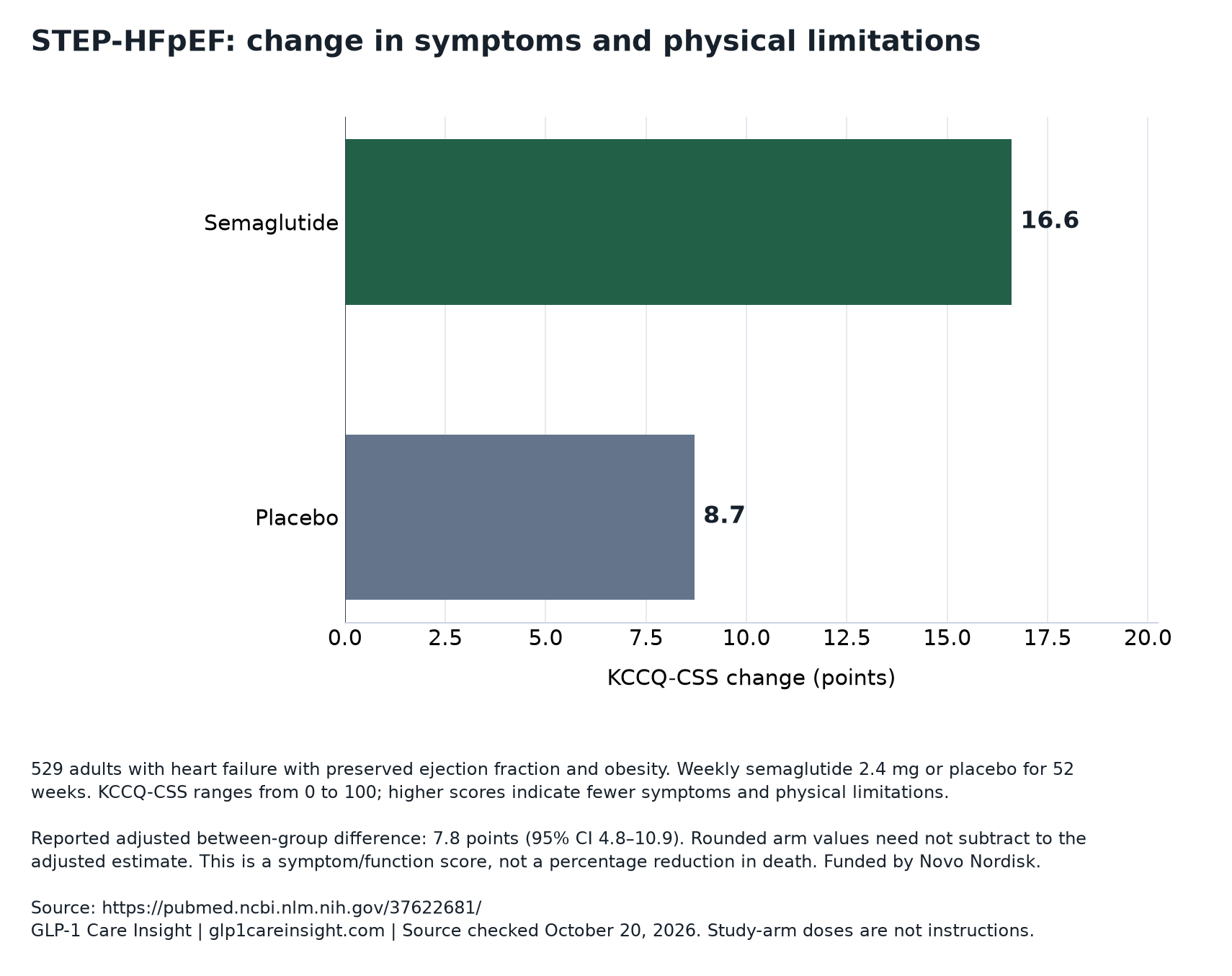
- Mean KCCQ-CSS improvement was 16.6 points with semaglutide and 8.7 with placebo; the reported estimated difference was 7.8 points, with a 95% confidence interval of 4.8 to 10.9.Sources: [1]
- Walking performance
- Six-minute walk distance improved by 21.5 meters versus 1.2 meters; the estimated between-group difference was 20.3 meters, with a 95% confidence interval of 8.6 to 32.1.Sources: [1]
- Weight change
- Mean weight change was −13.3% with semaglutide versus −2.6% with placebo, a reported difference of −10.7 percentage points.Sources: [1]
- Serious adverse events
- Serious adverse events were reported in 35 semaglutide participants, or 13.3%, and 71 placebo participants, or 26.7%; this measure is not a complete account of tolerability.Sources: [1]
Who was studied—and what the comparison can establish
Heart failure with preserved ejection fraction, or HFpEF, is not simply a normal heart with unexplained symptoms. “Preserved” describes the fraction of blood pumped out during contraction; it does not mean that overall heart function or exercise capacity is normal. STEP-HFpEF specifically enrolled people who had HFpEF together with obesity, defined here by a body-mass index of at least 30.
Participants were randomly assigned to once-weekly semaglutide 2.4 mg or placebo for 52 weeks. Randomization makes the between-group comparison more informative than observing people before and after treatment: it helps separate the treatment effect from changes that would have occurred anyway. The dose identifies the study arm, not a dosing recommendation. The indexed STEP-HFpEF abstract does not specify the administration route or escalation schedule.
The population boundary is essential. These findings do not automatically describe people with heart failure and lower body weight, other heart-failure phenotypes, or anyone seeking weight loss without heart failure. Nor does a year of observation establish lifelong benefit. The trial provides a focused answer about the participants and outcomes actually studied, rather than a universal claim about semaglutide.
Why symptoms and weight were separate primary endpoints
STEP-HFpEF had two primary endpoints: change in the Kansas City Cardiomyopathy Questionnaire clinical summary score, abbreviated KCCQ-CSS, and change in body weight. A primary endpoint is a main outcome selected to test the study’s central question. Having both prevented the investigation from treating weight loss alone as sufficient evidence of improved heart-failure health status.
KCCQ-CSS runs from 0 to 100, with higher scores indicating fewer symptoms and physical limitations. It is not a percentage of normal heart function, an ejection fraction, or a laboratory measurement. It captures participants’ reported health status. Weight change measures something different, so agreement between these endpoints strengthens the overall picture without making them interchangeable.
The reported changes favored semaglutide on both measures. That supports a conclusion that treatment improved more than body size in this trial. It does not show that each kilogram lost caused a particular symptom improvement. For a practical way to examine such claims, the evidence-questions guide helps separate the advertised outcome from what researchers actually measured.
| Outcome | Semaglutide versus placebo | Reported between-group estimate |
|---|---|---|
| KCCQ-CSS change | +16.6 versus +8.7 points | +7.8 points; 95% CI, 4.8 to 10.9 |
| Body-weight change | −13.3% versus −2.6% | −10.7 percentage points; 95% CI, −11.9 to −9.4 |
| Six-minute walk change | +21.5 versus +1.2 meters | +20.3 meters; 95% CI, 8.6 to 32.1 |
STUDY DATA · GLP-1 Care Insight
STEP-HFpEF: change in symptoms and physical limitations
529 adults with heart failure with preserved ejection fraction and obesity. Weekly semaglutide 2.4 mg or placebo for 52 weeks. KCCQ-CSS ranges from 0 to 100; higher scores indicate fewer symptoms and physical limitations.
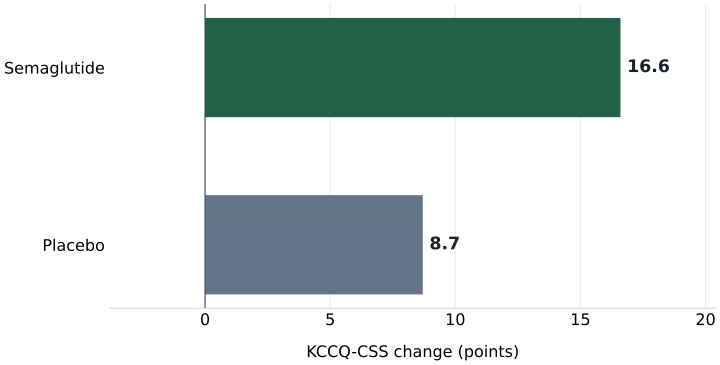
| Study group | KCCQ-CSS change (points) |
|---|---|
| Semaglutide | 16.6 |
| Placebo | 8.7 |
Reported adjusted between-group difference: 7.8 points (95% CI 4.8–10.9). Rounded arm values need not subtract to the adjusted estimate. This is a symptom/function score, not a percentage reduction in death. Funded by Novo Nordisk.
Original visualization of published aggregate data. No individual prediction or provider performance is represented. Original research ↗
Reading the 7.8-point symptom advantage correctly
Both groups improved on KCCQ-CSS: 16.6 points with semaglutide and 8.7 with placebo. The treatment comparison is therefore not 16.6 points against no improvement. It is the additional improvement associated with assignment to semaglutide rather than placebo. The placebo-group change also shows why an uncontrolled before-and-after account could overstate treatment benefit.
Subtracting the rounded displayed means gives 7.9 points, while the report’s estimated between-group difference is 7.8. The appropriate figure to carry forward is the reported estimate. Rounded group summaries need not reproduce an analysis estimate exactly; the abstract does not provide enough analytical detail to reconstruct the difference.
The 95% confidence interval, 4.8 to 10.9 points, expresses statistical uncertainty around the average treatment contrast. It is not a prediction that every participant improved within that range. The abstract does not show the distribution of individual responses or how many people reached a particular improvement threshold. A positive average is useful evidence, but it cannot tell an individual in advance how much better daily activities will feel.
Walking distance adds a different kind of evidence
The six-minute walk test measures distance covered during a fixed period. STEP-HFpEF treated change in this distance as a confirmatory secondary endpoint. Mean improvement was 21.5 meters with semaglutide and 1.2 meters with placebo, producing an estimated treatment difference of 20.3 meters. The 95% confidence interval ranged from 8.6 to 32.1 meters.
This test complements a questionnaire because it records performance rather than asking only how a person feels or functions. Agreement between the walking and KCCQ findings makes the functional result more persuasive than either measurement alone. Nevertheless, a standardized test does not directly measure every daily task, and a group-average gain cannot be converted into a guaranteed increase in someone’s walking range.
The interval also matters: the data support a positive average effect, while leaving uncertainty about its size. The trial abstract does not provide the detail needed to identify who gained the most distance, who did not improve, or whether changes remained after treatment ended. Those are distinct questions from whether the average 52-week comparison favored semaglutide.
Weight and inflammation changed, but causation remains unresolved
Mean body weight declined by 13.3% with semaglutide and 2.6% with placebo. Their reported contrast was −10.7 percentage points, with a 95% confidence interval of −11.9 to −9.4. Percentage points are the correct unit for subtracting two percentage changes. Calling this simply “10.7% more weight loss” would blur the distinction between an absolute difference in percentages and a relative comparison.
C-reactive protein, or CRP, was another confirmatory secondary endpoint. This blood marker of inflammation declined by a mean 43.5% with semaglutide and 7.3% with placebo. The reported treatment ratio was 0.61, with a 95% confidence interval of 0.51 to 0.72. That ratio is not the same calculation as subtracting the two displayed percentage changes.
These findings raise a mechanistic question rather than settle it: how much of the symptom benefit relates to weight reduction, inflammatory changes, or other effects? Randomization tested assignment to the treatment, not separate assignments to weight loss and inflammation reduction. The abstract therefore supports benefits occurring together, but not a precise causal breakdown of why symptoms and walking performance improved.
A win ratio is not a mortality risk reduction
STEP-HFpEF also used a hierarchical composite endpoint combining death, heart-failure events, and differences in KCCQ-CSS and walking-distance changes. A hierarchical analysis gives outcomes an order of priority rather than treating every outcome as equivalent. It compares treatment-group performance across that ordered framework and summarizes favorable versus unfavorable comparisons as a win ratio.
The reported win ratio was 1.72, with a 95% confidence interval of 1.37 to 2.15. This favored semaglutide within the composite framework. It does not mean mortality fell by 72%, nor does it mean 72% fewer participants experienced heart-failure events. Because symptoms and walking performance contribute to the hierarchy, a favorable overall result need not establish a separate benefit on death.
The abstract does not supply the component-level detail needed to determine exactly how much each outcome contributed to the win ratio. That is a central interpretive limit, not a reason to dismiss the result. The endpoint broadens the assessment of benefit, but it answers a different question from a time-to-first-event analysis of death or worsening heart failure.
Why SUMMIT adds evidence without ranking the drugs
SUMMIT randomized 731 people with heart failure, an ejection fraction of at least 50%, and BMI of at least 30 to tirzepatide or placebo. Tirzepatide was administered subcutaneously once weekly, up to 15 mg; these are study-arm details, not treatment instructions. Follow-up lasted at least 52 weeks, with a median of 104 weeks. Eli Lilly funded the study, whereas Novo Nordisk funded STEP-HFpEF.
SUMMIT’s primary event composite—cardiovascular death or worsening heart failure—occurred in 9.9% versus 15.3%, with a hazard ratio of 0.62 and 95% confidence interval of 0.41 to 0.95. The observed proportions differ by 5.4 percentage points; the hazard ratio instead compares event rates over time. Worsening heart-failure events favored tirzepatide, but cardiovascular deaths numbered eight versus five, with a highly uncertain hazard ratio of 1.58, confidence interval 0.52 to 4.83.
At 52 weeks, SUMMIT’s KCCQ-CSS difference was 6.9 points, with a confidence interval of 3.3 to 10.6. Comparing that directly with STEP-HFpEF’s 7.8 points cannot rank the medicines: participants, follow-up, and trial structures differed, and there was no direct randomized comparison. The SUMMIT analysis examines why its favorable composite does not establish that every component improved.
| Trial and population | Comparison and observation | Main endpoint focus |
|---|---|---|
| STEP-HFpEF: 529 people with HFpEF and obesity | Weekly semaglutide 2.4 mg versus placebo; 52 weeks | KCCQ-CSS and body-weight changes |
| SUMMIT: 731 people with HF, ejection fraction ≥50%, and obesity | Weekly subcutaneous tirzepatide up to 15 mg versus placebo; median follow-up 104 weeks | Cardiovascular death or worsening HF; KCCQ-CSS change |
| SELECT: 17,604 people with established cardiovascular disease, BMI ≥27, and no diabetes history | Weekly subcutaneous semaglutide 2.4 mg versus placebo; mean follow-up 39.8 months | Cardiovascular death, nonfatal heart attack, or nonfatal stroke |
SELECT answers a cardiovascular question, not the same HFpEF question
SELECT enrolled 17,604 adults aged at least 45 who had established cardiovascular disease, BMI of at least 27, and no history of diabetes. It compared once-weekly subcutaneous semaglutide 2.4 mg with placebo. Mean follow-up was 39.8 months, considerably longer than STEP-HFpEF’s 52-week assessment. Novo Nordisk funded both studies, but shared sponsorship and medication do not make their populations or endpoints interchangeable.
SELECT’s primary composite included cardiovascular death, nonfatal myocardial infarction, and nonfatal stroke. Events occurred in 569 of 8,803 semaglutide participants, or 6.5%, and 701 of 8,801 placebo participants, or 8.0%. The hazard ratio was 0.80, with a 95% confidence interval of 0.72 to 0.90. The observed event-percentage difference was 1.5 percentage points, not 20 percentage points.
The SELECT cardiovascular-outcomes analysis explains that endpoint in more detail. Its findings strengthen evidence for a particular cardiovascular benefit in the studied population, but they cannot substitute for a dedicated HFpEF mortality analysis. Likewise, STEP-HFpEF’s symptom gains do not establish that a person’s heart attack or stroke risk changed by a corresponding amount.
What the safety findings do—and do not—say
In STEP-HFpEF, serious adverse events were reported in 13.3% of semaglutide participants and 26.7% of placebo participants. These are important observed findings, but “serious adverse event” is not synonymous with “side effect caused by treatment.” Without a detailed breakdown, the abstract cannot show why the groups differed or describe the full range of treatment-related symptoms.
Other trials illustrate why tolerability needs its own measure. In SUMMIT, adverse events leading to drug discontinuation, mainly gastrointestinal, occurred in 6.3% with tirzepatide and 1.4% with placebo. In SELECT, adverse events leading to permanent trial-product discontinuation occurred in 16.6% with semaglutide and 8.2% with placebo. These are different studies and observation periods, not a valid cross-trial safety ranking.
A treatment can improve clinical outcomes while still causing symptoms that lead some people to stop it. Conversely, fewer serious events do not imply an absence of burdensome adverse effects. The consultation-questions guide can help organize separate questions about expected benefit, tolerability, and follow-up rather than collapsing all three into whether a medicine is “safe.”
Turning trial evidence into better questions about care
The most useful discussion begins by identifying the intended outcome: fewer symptoms, better function, weight reduction, or prevention of clinical events. STEP-HFpEF supports some of these claims more directly than others. Questions about how health status will be assessed and how adverse effects will be handled are more informative than asking whether an individual will reproduce the trial average.
Product identity is a separate evidence boundary. FDA states that compounded drugs are not FDA approved or reviewed before marketing for safety, effectiveness, or quality, and identifies concerns including dosing errors and semaglutide salt ingredients. Results from these trials do not establish equivalent outcomes for compounded preparations, oral routes, or other formulations. The medication-questions guide provides a framework for clarifying what product an offer actually concerns.
Editorial interpretation: a clinical trial also does not validate a provider’s contract, charges, or support arrangements. Documentary resources such as the CoreAge Rx review and Mochi Health review can be used to check terms before enrollment. Those links do not imply that either provider offers the studied product, provides HFpEF-specific care, or delivers the trial’s outcomes.
Questions & answers
Does a 7.8-point KCCQ-CSS difference mean 7.8% better heart function?
No. KCCQ-CSS is a 0–100 symptom and physical-limitation score, not a percentage measurement of heart function. The 7.8-point estimate describes the average additional improvement with semaglutide versus placebo. It does not describe a change in ejection fraction or predict each participant’s response.
Did STEP-HFpEF show that semaglutide helps people live longer?
The abstract does not establish a mortality benefit. Its primary endpoints were health-status and weight changes. Death contributed to a hierarchical composite, but the favorable win ratio cannot be converted into a mortality hazard ratio or a percentage reduction in deaths.
Why did the placebo group’s symptoms also improve?
The abstract reports the improvement but does not isolate its causes. Possible explanations should not be treated as measured findings. The key design advantage is that randomization provides a concurrent comparison: semaglutide’s effect is assessed against the improvement observed with placebo, rather than against an assumption of no change.
Does SUMMIT prove tirzepatide is better than semaglutide for HFpEF?
No. SUMMIT and STEP-HFpEF compared different medicines with placebo, not with each other. Their populations, follow-up, and endpoints differed. SUMMIT adds evidence about a heart-failure event composite, but comparing separate trials cannot reliably determine which medicine would produce better outcomes in the same patients.
Can a compounded semaglutide offer claim the same HFpEF results?
These trials do not establish equivalence for compounded preparations. FDA says compounded drugs are not FDA approved and are not reviewed before marketing for safety, effectiveness, or quality. A matching ingredient name or advertised dose does not by itself demonstrate the same formulation, quality, or clinical outcomes.
Our assessment
STEP-HFpEF provides randomized evidence that semaglutide improved average symptoms, physical limitations, walking performance, and weight over 52 weeks in people with HFpEF and obesity. The concordant findings matter because they extend beyond weight alone. Its main unresolved questions concern individual response, durability beyond the studied period, the mechanisms connecting weight and health-status changes, and effects on specific clinical events. SUMMIT and SELECT supply complementary evidence, not interchangeable answers. The clearest reading preserves each trial’s population, comparator, endpoint, and uncertainty rather than compressing them into a single claim of cardiovascular benefit.
Sources & documentation
Scientific and official sources consulted October 20, 2026. Study findings apply to the populations, products and time periods described; they are not provider outcome data.