The STEP 1 extension is often reduced to a single message: people regained two-thirds of the weight they lost after stopping semaglutide. That accurately summarizes the group average, but leaves out facts that change its interpretation. The follow-up involved 327 selected participants who had completed treatment, not everyone originally randomized. Medication and structured lifestyle support ended together. One year later, average weight remained below its starting level, and individual results varied substantially.
The study therefore answers a narrower, more useful question than whether everyone must take medication indefinitely: what happened over the following year among treatment completers after a specific trial program ended? This analysis uses the accessible extension full article, the indexed primary report abstracts for STEP 1 and the comparison trials, and official FDA material. It does not assume that every protocol or supplement was examined. The central task is separating observed results from predictions about an individual’s future.
At a glance
- Selected follow-up population
- The exploratory extension analysis included 327 treatment completers, compared with 1,961 adults randomized in the original STEP 1 trial.
- Two interventions ended
- At week 68, both study medication and structured lifestyle intervention stopped; follow-up continued through week 120.Sources: [1]
- Average regain
- The former semaglutide group regained 11.6 percentage points of baseline body weight after an initial average loss of 17.3%.Sources: [1]
- Residual weight loss
- At week 120, average weight remained 5.6% below baseline; 95 of 197 participants with onsite measurements retained at least 5% weight loss.Sources: [1]
The randomized trial came before the observational follow-up
STEP 1 enrolled adults without diabetes whose body mass index, or BMI, was at least 30, or at least 27 with a weight-related condition. BMI relates weight to height; it was an eligibility measure, not a complete description of health. Across 129 sites in 16 countries, 1,961 participants were randomly assigned in a 2:1 ratio to semaglutide or placebo.
The intervention was once-weekly subcutaneous semaglutide, meaning an injection under the skin, with a target study dose of 2.4 mg after 16 weeks of escalation. Both groups received lifestyle counseling throughout the 68-week treatment phase. These doses identify the research arms, not instructions for treatment. Novo Nordisk funded STEP 1 and its extension; several extension authors were company employees.
The original trial’s coprimary endpoints were percentage weight change and achieving at least 5% weight loss at week 68. Its main analysis addressed effects regardless of discontinuation or rescue interventions. By contrast, the extension’s weight and laboratory outcomes were exploratory: there was no new random assignment to continue versus stop treatment.
Why 327 participants cannot stand in for every treatment starter
Extension eligibility required completing 68 weeks of assigned treatment and agreeing to further follow-up. Selected sites were in Canada, Germany, the United Kingdom, the United States, and Japan. US and Japanese sites were chosen for high recruitment. Of 333 people entering the extension, 327 attended at least one qualifying follow-up visit: 228 formerly assigned semaglutide and 99 formerly assigned placebo.
Participants averaged 49 years of age, a BMI of 37.6, and a weight of 105.5 kg; 67.0% were female and 75.8% were White. Their baseline characteristics broadly resembled the original trial population. Nevertheless, requiring treatment completion excludes people who stopped earlier, including some whose experience may have been less favorable.
That distinction helps explain why average semaglutide-associated loss at week 68 was 17.3% in the extension sample but 14.9% in the full trial analysis. Those numbers do not conflict: they describe different analysis populations and methods. The guide to questioning advertised weight-loss percentages offers a practical framework for identifying which population a headline actually represents.
STUDY DATA · GLP-1 Care Insight
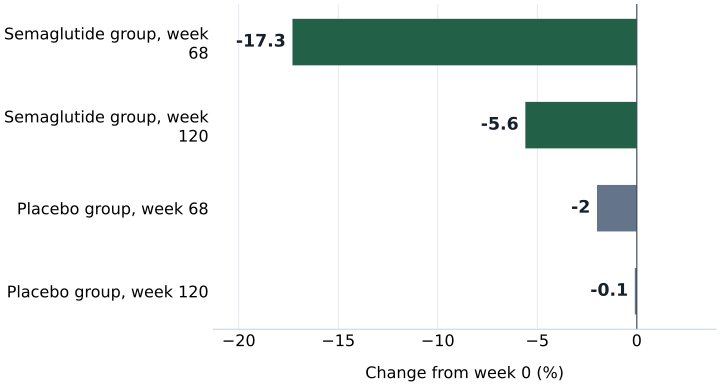
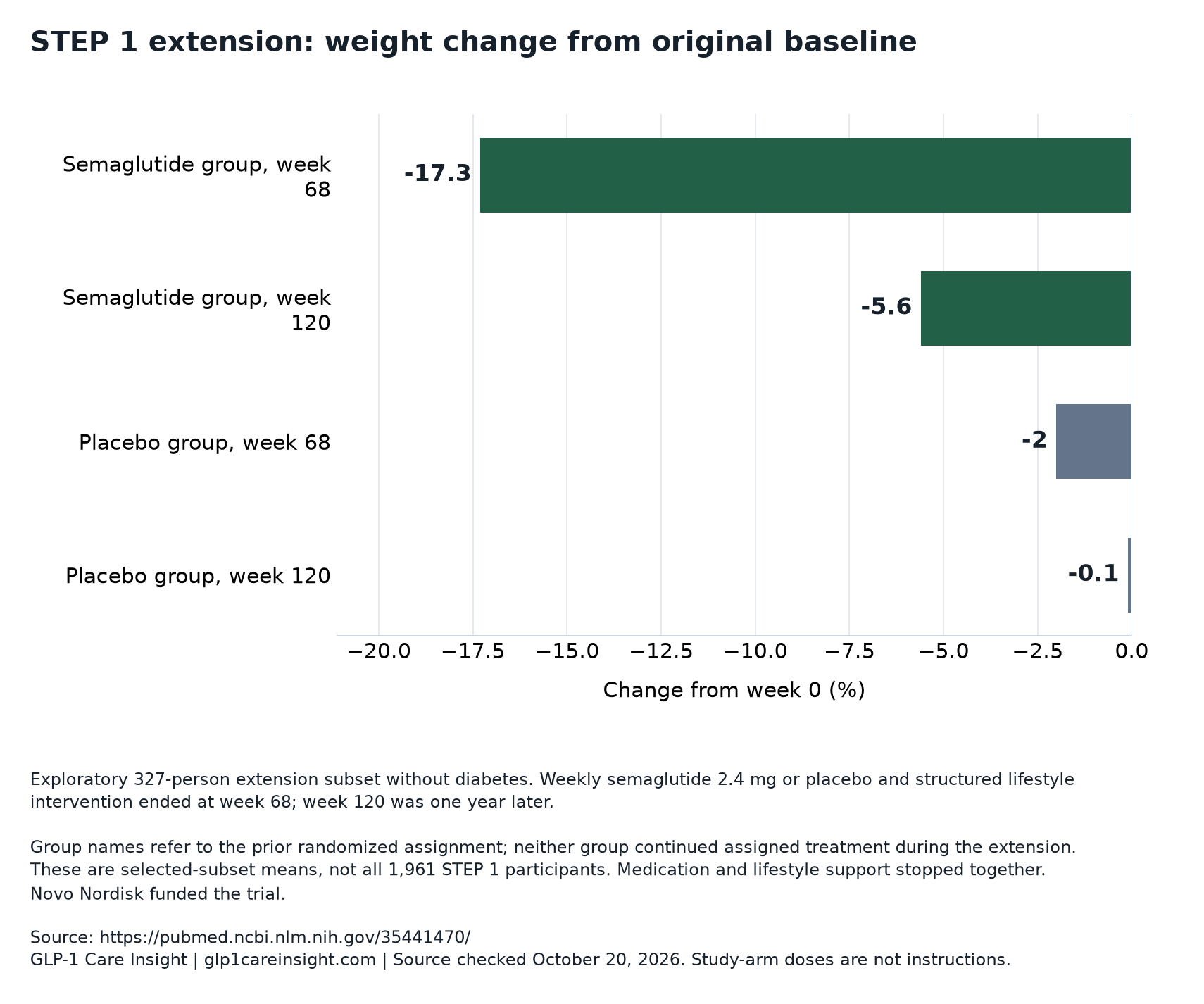
STEP 1 extension: weight change from original baseline
Exploratory 327-person extension subset without diabetes. Weekly semaglutide 2.4 mg or placebo and structured lifestyle intervention ended at week 68; week 120 was one year later.
| Study group | Change from week 0 (%) |
|---|---|
| Semaglutide group, week 68 | -17.3 |
| Semaglutide group, week 120 | -5.6 |
| Placebo group, week 68 | -2 |
| Placebo group, week 120 | -0.1 |
Group names refer to the prior randomized assignment; neither group continued assigned treatment during the extension. These are selected-subset means, not all 1,961 STEP 1 participants. Medication and lifestyle support stopped together. Novo Nordisk funded the trial.
Original visualization of published aggregate data. No individual prediction or provider performance is represented. Original research ↗
What changed when treatment ended
At week 68, both assigned medication and the structured lifestyle intervention stopped. During treatment, participants had received counseling every four weeks about diet and physical activity. Ending that program changed more than drug exposure, so the subsequent trajectory cannot isolate the effect of stopping semaglutide alone.
Follow-up measurements were scheduled at weeks 75, 80, 104, and 120, with week 120 marking 52 weeks off assigned treatment. Investigators and participants remained unaware of the original treatment allocation until extension completion. No treatments were actively administered or prohibited during follow-up, making this an observational period rather than a tightly controlled comparison of maintenance strategies.
Importantly, withdrawal of counseling does not mean participants stopped every personal lifestyle effort. Participation in outside lifestyle interventions was not recorded. Some also used weight-management medications: investigator classifications identified use in 9.2% of the former semaglutide arm and 6.1% of the former placebo arm. Excluding those users produced similar average weight trajectories, but did not turn the extension into a randomized withdrawal experiment.
Translating two-thirds regain without changing the denominator
In the extension sample, average loss through week 68 was 17.3% with semaglutide and 2.0% with placebo. Over the next year, the groups regained 11.6 and 1.9 percentage points of baseline body weight, respectively. The resulting reported net losses at week 120 were 5.6% and 0.1%.
The two-thirds description comes from dividing 11.6 by 17.3, which is approximately 0.67. Its denominator is the weight previously lost—not the person’s starting weight, and not their weight when treatment stopped. Likewise, 11.6 percentage points is not interchangeable with an 11.6% increase from the lower, week-68 weight.
For illustration only, someone starting at 100 kg who lost 17.3% would reach 82.7 kg. Adding 11.6 kg would place them around 94.3 kg: approximately 14% above the lower weight but still below baseline. This constructed example explains the arithmetic; it is not a participant history. Rounded reported averages need not subtract exactly, particularly when available observations change across visits.
| Measurement | Reported semaglutide-arm result | Correct interpretation |
|---|---|---|
| Initial loss, weeks 0–68 | 17.3% of baseline weight | Average reduction during assigned treatment in the extension sample |
| Regain, weeks 68–120 | 11.6 percentage points of baseline weight | About two-thirds of the previously lost weight returned |
| Net change, weeks 0–120 | 5.6% below baseline | Average residual loss after one year off assigned treatment |
The average conceals meaningful differences between people
The standard deviation of initial semaglutide-arm weight loss was 9.3 percentage points; the standard deviation of regain was 7.7 points, and that of net loss at week 120 was 8.9 points. Standard deviation describes spread around an average. These wide values show why the mean cannot serve as a precise forecast, although they do not establish the probability of any particular person’s outcome.
Among participants with onsite measurements at week 120, 48.2% in the former semaglutide arm—95 of 197—still had at least 5% weight loss from baseline. The corresponding placebo figure was 22.6%, or 21 of 93. Retaining that threshold does not mean no regain occurred; someone can regain a substantial amount and still remain at least 5% below their starting weight.
Exploratory analyses also found that participants with larger initial losses tended to regain more afterward while retaining larger net losses at the end. That is not evidence that losing more was harmful. It illustrates why kilograms regained, the fraction of prior loss regained, and residual loss answer different questions. None identifies a reliable individual maintenance rule.
Blood pressure and laboratory results did not move uniformly
Many cardiometabolic improvements moved back toward baseline, but not every measurement followed the same course. In the former semaglutide arm, average systolic blood pressure changed from 129 mmHg at baseline to 121 at week 68 and 131 at week 120. Average diastolic pressure moved from 81 to 78 to 82 mmHg. Thus, the earlier blood-pressure improvement was not maintained at the group level.
HbA1c, a measure reflecting average blood glucose, changed from 5.7% to 5.2% to 5.6%. Among participants with prediabetes at baseline, 93.6% had values in the normal glycemic category at week 68, compared with 43.3% at week 120. These observed category changes describe laboratory status at visits; they do not establish permanent resolution or an individual’s future diabetes risk.
Some residual improvements persisted in lipids and C-reactive protein, an inflammation marker. For example, triglycerides in the semaglutide arm were 131.1 mg/dL at baseline, 95.7 at week 68, and 122.4 at week 120, expressed as geometric means. These are risk-factor measurements, not proof of fewer heart attacks after withdrawal. The study also could not determine how much of each change reflected weight regain versus loss of direct medication effects.
Missing measurements limit the precision of the story
Although 312 of 333 extension entrants completed follow-up, only 290 had onsite data at week 120. Another 22 completed the final visit by telephone or email. Pandemic-related remote visits helped preserve contact, but self-reported measurements were excluded from the analyses. Therefore, study completion and availability of measured weight were not equivalent.
The off-treatment analyses used observed data, with no formal sample-size power calculation for the extension. The headline regain estimates were descriptive and reported with standard deviations, not a confidence interval for a randomized stopping-versus-continuation effect. If people missing measured visits had different weight trajectories, the observed average could differ from the average for all extension entrants.
Confidence intervals reported for treatment-phase comparisons should not be mistaken for uncertainty bounds around regain. In the original STEP 1 analysis, the week-68 treatment difference was −12.4 percentage points, with a 95% confidence interval of −13.4 to −11.5. That estimates the randomized treatment contrast during treatment—not what would happen to every participant after stopping.
Why other maintenance trials report different numbers
SURMOUNT-4 tested a different drug and a stronger withdrawal comparison. After a 36-week open-label tirzepatide lead-in, 670 participants were randomized to continue once-weekly injections at their maximum tolerated study dose of 10 or 15 mg or switch to placebo for 52 weeks. Diet and physical activity remained part of the study context. The SURMOUNT-4 analysis explains why that design more directly addresses continuation versus withdrawal.
Participants had lost an average 20.9% before randomization. From that new starting point, weight changed by −5.5% with continued tirzepatide and +14.0% after switching to placebo; the estimated difference was −19.4 percentage points, with a 95% confidence interval of −21.2 to −17.7. That 14.0% gain uses week-36 weight as its denominator, unlike STEP 1’s regain expressed in baseline-weight percentage points.
The Eli Lilly-funded SURMOUNT-MAINTAIN trial asked another question: after 60 weeks of tirzepatide, how did continuing maximum tolerated treatment, reducing to a 5-mg study arm, or switching to placebo compare over 52 weeks? Baseline-to-week-112 estimates were −21.9%, −16.6%, and −9.9%, respectively. Rescue treatment and its specified statistical handling were additional differences. Neither tirzepatide trial establishes a semaglutide dose-reduction strategy, and scale outcomes alone do not resolve questions addressed by body-composition research.
| Study | Post-loss comparison | Main interpretive distinction |
|---|---|---|
| STEP 1 extension | Observational follow-up after semaglutide/placebo and structured support ended | No newly randomized continuation group; selected treatment completers |
| SURMOUNT-4 | Continue tirzepatide versus switch to placebo after 36 weeks | Primary weight-change denominator was weight at randomization |
| SURMOUNT-MAINTAIN | Continue maximum tolerated tirzepatide, reduce to 5 mg, or switch to placebo after 60 weeks | Primary endpoint was baseline-to-week-112 change, with rescue-treatment assumptions |
Safety cannot be inferred from a weight curve
The STEP 1 extension did not systematically collect adverse events. It therefore cannot provide a comprehensive account of symptoms after withdrawal or compare the long-term safety of stopping against continuing. A rise in weight or a laboratory value is not itself a complete adverse-event assessment.
During the original randomized STEP 1 treatment phase, nausea and diarrhea were the most common semaglutide adverse events, generally transient and mild to moderate. Gastrointestinal events prompted discontinuation in 59 participants receiving semaglutide, or 4.5%, versus five receiving placebo, or 0.8%. The tirzepatide maintenance abstracts likewise reported predominantly gastrointestinal events, mostly mild to moderate; SURMOUNT-MAINTAIN reported that these mainly occurred during escalation.
Product identity matters as well. FDA states that compounded drugs are not approved or reviewed before marketing for safety, effectiveness, or quality, and identifies concerns including dosing errors and semaglutide salt ingredients. These trial results do not establish equivalent effects for compounded preparations, oral routes, or other formulations. The medication-identity questions help keep that distinction separate from a program’s marketing.
A better conversation than “Will I regain everything?”
The evidence supports discussing maintenance before a treatment course ends, but not predicting inevitable complete regain. Useful clinical questions concern which measurements will be followed, what uncertainty remains, and how a change in treatment would be evaluated. The consultation-question guide can organize that discussion without turning trial averages into personalized dosing or stopping instructions.
Editorial interpretation: recurring costs and administrative interruptions make continuity a planning issue, even though STEP 1 did not study prices, insurance, or contracts. It is reasonable to ask what a program documents about follow-up, renewal, and access when circumstances change. A documentary review such as the Ro Body review can help check written terms; it does not establish availability of the studied product, condition-specific care, or trial-like outcomes.
The unresolved scientific questions are substantial: whether average regain would eventually plateau, how continued structured support would change this trajectory, which maintenance approaches work best after semaglutide, and whether individual outcomes can be predicted reliably. The extension supplies one year of observation, not a lifetime comparison of every possible care strategy.
Questions & answers
Does two-thirds regain mean two-thirds of participants regained weight?
No. It describes the ratio of average weight regained to average weight previously lost in the former semaglutide group. It is not the proportion of participants who regained, and it does not describe an identical trajectory for everyone. The reported spread in weight changes was substantial.
Did the extension prove that stopping semaglutide alone caused all the regain?
No. Structured lifestyle support ended at the same time, and participants were not newly randomized to stop versus continue. The results document regain after the combined trial program ended. They cannot divide that regain into separate medication-withdrawal and support-withdrawal effects.
Why is the initial weight loss sometimes reported as 14.9% and sometimes 17.3%?
The 14.9% estimate comes from the original trial’s broader randomized analysis. The 17.3% figure describes the selected extension sample, whose members completed treatment. Different populations and analysis approaches can produce different valid estimates. Using the larger completer result as a promise to all treatment starters would misrepresent the evidence.
Does this prove everyone needs lifelong medication?
No. It supports the importance of ongoing maintenance care and shows substantial average regain over one year after withdrawal. It did not compare lifelong treatment with every alternative, identify who could maintain loss without medication, or establish an individualized stopping rule. Continued treatment also requires weighing benefits against adverse effects and other clinical considerations.
Can the reduced-dose tirzepatide study answer how to taper semaglutide?
No. SURMOUNT-MAINTAIN studied fixed tirzepatide maintenance arms after a specific lead-in, with rescue treatment available under defined conditions. It did not test a semaglutide taper. Its results inform questions about maintenance research, but are not transferable instructions for changing another medication.
Our assessment
The STEP 1 extension provides persuasive descriptive evidence that substantial weight regain can follow the end of semaglutide treatment and structured lifestyle support. Its strongest contribution is the measured one-year trajectory, including residual weight loss and partial reversal of cardiometabolic improvements. Its weakest use is as a universal prediction. Selected completers, missing onsite measurements, simultaneous withdrawal of two interventions, and the absence of a randomized continuation group all narrow the conclusions. Read alongside randomized maintenance trials, it supports planning for long-term management—not assuming either permanent benefit after withdrawal or inevitable complete regain for everyone.
Sources & documentation
Scientific and official sources consulted October 20, 2026. Study findings apply to the populations, products and time periods described; they are not provider outcome data.
- Weight regain and cardiometabolic effects after withdrawal of semaglutide: The STEP 1 trial extension. ↗
- Once-Weekly Semaglutide in Adults with Overweight or Obesity. ↗
- Continued Treatment With Tirzepatide for Maintenance of Weight Reduction in Adults With Obesity: The SURMOUNT-4 Randomized Clinical Trial. ↗
- Tirzepatide for maintenance of bodyweight reduction in people with obesity in the USA (SURMOUNT-MAINTAIN): a multicentre, double-blind, randomised, placebo-controlled trial. ↗
- FDA concerns about unapproved GLP-1 drugs ↗