A sleep-apnea result expressed as 20 fewer events per hour can sound straightforward. It is not the same as 20 fewer events in a night, a 20% improvement, or proof that sleep apnea has disappeared. SURMOUNT-OSA provides evidence that tirzepatide can reduce obstructive sleep apnea severity in adults with obesity, but the practical meaning depends on the starting severity, the comparison group, and what remains after treatment.
The evidence comes from two randomized trials distinguished by positive airway pressure, or PAP, use at baseline. This analysis uses the indexed primary report abstract and available official FDA and NIDDK material, not a review of all full-text protocols or supplements. The central question is how to understand a large average improvement without turning it into an unsupported promise about an individual’s diagnosis, PAP needs, cardiovascular prognosis, or treatment access.
At a glance
- Who participated
- The FDA describes 469 adults with moderate-to-severe obstructive sleep apnea and obesity, without type 2 diabetes, across two studies.Sources: [2]
- Why there were two trials
- Trial 1 enrolled people not receiving PAP at baseline; trial 2 enrolled people receiving PAP at baseline.Sources: [1]
- What was tested
- Participants were randomized to tirzepatide or placebo for 52 weeks. The studied active arms used maximum tolerated 10 mg or 15 mg weekly injections.
- Primary result
- The placebo-adjusted AHI change was −20.0 events per hour in trial 1 and −23.8 events per hour in trial 2.Sources: [1]
- Reported tolerability
- The most frequently reported tirzepatide adverse events were gastrointestinal and mostly mild to moderate; the indexed abstract does not give their event rates.Sources: [1]
Two PAP-use populations, not a trial of PAP versus medication
SURMOUNT-OSA consisted of two phase 3, double-blind, randomized, placebo-controlled trials. Randomization assigned participants within each trial in a 1:1 ratio to tirzepatide or placebo. Double-blinding means treatment assignment was concealed from participants and investigators, helping limit differences in expectations and assessment between treatment groups.
The dividing line between trials was existing PAP use. Trial 1 enrolled people not receiving PAP at baseline; the FDA describes this population as unable or unwilling to use PAP. Trial 2 enrolled people receiving PAP. This structure addressed two clinical contexts, rather than treating everyone with sleep apnea as one interchangeable population.
Crucially, participants were not randomized between PAP and no PAP. The studies therefore cannot establish that medication is better than PAP, or that adding medication makes PAP unnecessary. The accessible abstract also does not specify the detailed PAP handling around sleep measurements. Knowing baseline PAP status is not enough to reconstruct that testing protocol.
| Measure | Trial 1 | Trial 2 |
|---|---|---|
| PAP at baseline | Not receiving PAP | Receiving PAP |
| Mean baseline AHI | 51.5 events/hour | 49.5 events/hour |
| Mean baseline BMI | 39.1 | 38.7 |
| Tirzepatide AHI change at week 52 | −25.3 events/hour | −29.3 events/hour |
| Placebo AHI change at week 52 | −5.3 events/hour | −5.5 events/hour |
| Estimated treatment difference | −20.0 events/hour | −23.8 events/hour |
The participants and regimen define the evidence boundary
The FDA identifies 469 participants across the two studies, all adults with obesity and moderate-to-severe obstructive sleep apnea, without type 2 diabetes. Their mean baseline apnea-hypopnea index was approximately 50 events per hour in both trials. Mean body-mass index, a weight-to-height measure, was approximately 39. These averages describe the study populations, not entry criteria for every future patient.
The active treatment was injectable tirzepatide, given weekly, with a maximum tolerated dose of 10 mg or 15 mg. Those doses identify the research arms; they are not instructions for starting treatment. Follow-up for the primary sleep outcome was 52 weeks. Eli Lilly funded SURMOUNT-OSA, which is registered as NCT05412004.
The FDA’s December 20, 2024 announcement approved Zepbound for moderate-to-severe obstructive sleep apnea in adults with obesity alongside reduced-calorie diet and increased physical activity. That dated announcement establishes approval context, not complete current prescribing information. Results should not automatically be extended to people without obesity, children, other sleep-breathing disorders, or formulations that were not studied.
STUDY DATA · GLP-1 Care Insight
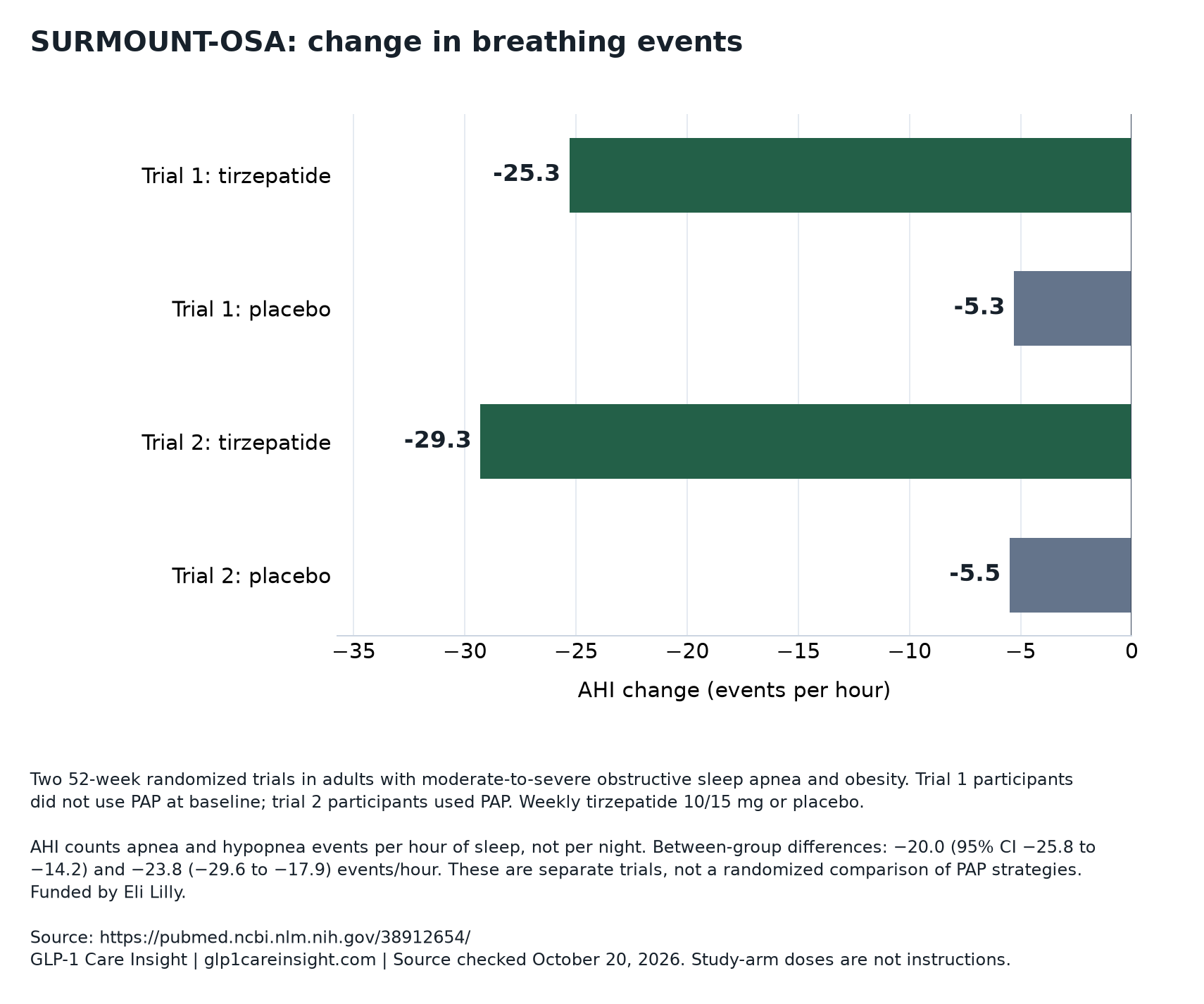
SURMOUNT-OSA: change in breathing events
Two 52-week randomized trials in adults with moderate-to-severe obstructive sleep apnea and obesity. Trial 1 participants did not use PAP at baseline; trial 2 participants used PAP. Weekly tirzepatide 10/15 mg or placebo.
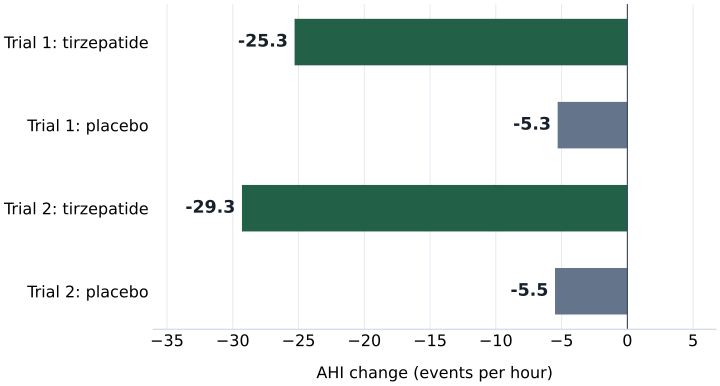
| Study group | AHI change (events per hour) |
|---|---|
| Trial 1: tirzepatide | -25.3 |
| Trial 1: placebo | -5.3 |
| Trial 2: tirzepatide | -29.3 |
| Trial 2: placebo | -5.5 |
AHI counts apnea and hypopnea events per hour of sleep, not per night. Between-group differences: −20.0 (95% CI −25.8 to −14.2) and −23.8 (−29.6 to −17.9) events/hour. These are separate trials, not a randomized comparison of PAP strategies. Funded by Eli Lilly.
Original visualization of published aggregate data. No individual prediction or provider performance is represented. Original research ↗
AHI counts events per hour—not per night
The primary endpoint was change in the apnea-hypopnea index, abbreviated AHI, from baseline to week 52. AHI counts apneas and hypopneas—breathing interruptions and reductions—per hour of sleep. A value of 50 means an average of 50 scored events for each hour slept, not 50 across the whole night.
A purely illustrative calculation shows the units: an AHI of 50 over six hours corresponds to 300 scored events. AHI of 30 over the same duration corresponds to 180. This is arithmetic, not a reconstruction of participants’ nights, because actual sleep duration and individual event patterns are not supplied. The hourly denominator allows comparisons without assuming identical sleep duration.
An absolute AHI decrease also differs from a percentage decrease. Going from 50 to 30 events per hour is a reduction of 20 events per hour and 40% relative to that starting value. SURMOUNT-OSA’s primary result used absolute change; percentage change was a secondary endpoint. The guide to questioning advertised percentages offers a useful framework for keeping the measure and denominator visible.
Why the placebo-adjusted result matters
In trial 1, mean AHI fell by 25.3 events per hour with tirzepatide and by 5.3 with placebo. The estimated treatment difference was therefore −20.0 events per hour. Reporting the full 25.3-event decrease as the medication’s advantage would overlook improvement observed in the comparison group.
In trial 2, the corresponding changes were −29.3 and −5.5 events per hour, yielding an estimated treatment difference of −23.8. Both trials favored tirzepatide. Their separate results show that benefit was detected in both baseline PAP-use settings; they do not establish why the numerical treatment differences were different.
Placebo-group improvement does not mean the comparison was uninformative. It is precisely why a randomized comparator matters: before-and-after change alone can combine treatment effects with other changes during follow-up and measurement variation. The accessible abstract does not separate the reasons for placebo-group improvement, so attributing it to any one cause would go beyond the evidence.
| Estimate | Trial 1: estimate (95% CI) | Trial 2: estimate (95% CI) |
|---|---|---|
| Tirzepatide change | −25.3 (−29.3 to −21.2) | −29.3 (−33.2 to −25.4) |
| Placebo change | −5.3 (−9.4 to −1.1) | −5.5 (−9.9 to −1.2) |
| Tirzepatide minus placebo | −20.0 (−25.8 to −14.2) | −23.8 (−29.6 to −17.9) |
Confidence intervals describe estimates, not personal forecasts
A confidence interval expresses uncertainty around an estimated population effect under the study’s statistical approach. Trial 1’s treatment difference had a 95% confidence interval from −25.8 to −14.2 events per hour. Trial 2’s interval extended from −29.6 to −17.9. Both intervals remained on the side favoring tirzepatide.
These intervals are not ranges within which 95% of individual patients’ improvements should fall. A person can improve more or less than an average effect, and the abstract does not provide a complete distribution of individual responses. Precision about the average is different from the ability to predict one person’s outcome.
Nor does trial 2’s larger point estimate establish a stronger effect among PAP users. The trials involved different baseline-use populations, and the abstract reports no direct test showing that PAP status modified treatment benefit. Their intervals overlap, but overlap alone is not a formal test of equality either. The appropriate reading is two favorable estimates, not a proven ranking of patient groups.
Large improvement can coexist with residual sleep apnea
A large reduction from a high starting AHI can leave substantial breathing disturbance. As an illustrative example, a person starting at 50 events per hour who improves by 25 would still have 25 events per hour. That example explains residual disease; it is not an observed individual result or a trial remission estimate.
The reported baseline averages and average changes should not be used to calculate how many participants no longer had clinically important apnea. That requires individual follow-up measurements and a stated outcome definition. The indexed abstract does not provide remission proportions or enough detail to reconstruct them reliably.
This is why diagnostic follow-up is a different question from whether treatment worked on average. A conversation with the treating sleep clinician can distinguish current symptoms, objective breathing severity, and PAP management. Neither weight loss nor feeling more rested establishes that obstruction has resolved. SURMOUNT-OSA is not permission to stop PAP, and its headline result does not specify an individual retesting schedule.
Oxygen burden and sleep experience add different information
AHI was not the only outcome. Prespecified key secondary endpoints included percentage changes in AHI and body weight, hypoxic burden, patient-reported sleep impairment and disturbance, high-sensitivity C-reactive protein, and systolic blood pressure. The report describes statistically significant improvements versus placebo in all these key secondary measurements.
These endpoints address different dimensions. Hypoxic burden concerns oxygen shortfall during sleep, rather than simply counting breathing events. Patient-reported measures address how sleep problems are experienced. High-sensitivity C-reactive protein is an inflammation marker, while systolic blood pressure is the upper pressure reading. Improvement across these measures broadens the result beyond event counting.
However, the abstract does not supply their numerical effects or confidence intervals. It therefore supports the direction of the findings, not a precise estimate of how much better someone might feel or how much blood pressure might fall. Concurrent weight and AHI improvements also do not, by themselves, quantify how much of the breathing benefit was caused by weight loss versus other pathways.
Sleep endpoints are not cardiovascular-event endpoints
Obstructive sleep apnea is associated with cardiovascular complications, but SURMOUNT-OSA’s primary endpoint was breathing-event frequency. Improvements in blood pressure, inflammation, or oxygen burden do not establish fewer heart attacks, strokes, heart-failure events, or deaths. Those are separate outcomes requiring direct study.
SUMMIT illustrates the distinction. It randomized 731 people with obesity and heart failure with preserved ejection fraction to weekly subcutaneous tirzepatide, up to 15 mg, or placebo. Over a median 104 weeks, cardiovascular death or worsening heart failure occurred in 9.9% versus 15.3%; the hazard ratio was 0.62, with a 95% confidence interval of 0.41–0.95. A hazard ratio is a time-to-event comparison, not an AHI reduction or a percentage-point difference.
Even there, the composite did not mean every component improved: cardiovascular deaths were 8 versus 5, with an imprecise hazard ratio of 1.58 and confidence interval of 0.52–4.83. Worsening heart-failure events favored tirzepatide. The SUMMIT analysis explores that distinction. Its disease-specific results cannot be reassigned to SURMOUNT-OSA participants simply because the medication was the same.
Tolerability and durability remain separate questions
The SURMOUNT-OSA abstract identifies gastrointestinal adverse events as the most frequently reported events with tirzepatide, mostly mild to moderate in severity. That is a real tolerability finding, not evidence of no harm. Without event counts, discontinuation rates, or detailed serious-event results in this abstract, a numerical benefit-harm balance cannot be calculated from it.
Safety numbers from another trial should remain attached to that trial. In SUMMIT, adverse events, mainly gastrointestinal, led to treatment discontinuation in 6.3% of tirzepatide participants versus 1.4% with placebo. Those figures describe a heart-failure population and its study conditions; they are not SURMOUNT-OSA discontinuation rates.
Durability is another unresolved issue. A 52-week result does not establish lifelong breathing benefit or what happens to AHI after treatment ends. NIDDK notes that weight regain can occur after stopping weight-management medicines, but that does not quantify sleep-apnea recurrence. The randomized-withdrawal discussion helps frame the distinction between evidence during treatment and evidence after withdrawal, without supplying missing sleep outcomes.
Translate the evidence into questions, not product equivalence
Useful consultation questions follow directly from the study: Does the diagnosis match the studied condition? What objective measurement would assess response? Who coordinates sleep follow-up and PAP decisions? How would adverse effects and ongoing benefit be evaluated? The consultation-question guide can organize these topics without turning a trial average into a personal treatment plan.
Product identity also matters. FDA states that compounded drugs are not FDA approved or reviewed before marketing for safety, effectiveness, or quality, and recommends them only when a patient’s needs cannot be met by an approved drug. SURMOUNT-OSA does not establish equivalent sleep outcomes for compounded preparations, oral routes, or other formulations. The medication-identity guide separates those documentary questions from efficacy claims.
Editorial interpretation: treatment access and contract terms deserve their own scrutiny because a positive clinical trial does not guarantee coverage, affordability, or coordinated follow-up. NIDDK explicitly notes that coverage varies. If comparing enrollment documents, the Mochi Health review is a place to check documentary terms—not evidence that a provider supplies the studied product, offers apnea-specific care, or reproduces these outcomes.
Questions & answers
Were the 469 participants all using PAP?
No. The FDA’s total covers both studies. One enrolled adults receiving PAP, while the other enrolled adults not receiving it, described by FDA as unable or unwilling to use PAP. Randomization compared tirzepatide with placebo within those settings; it did not randomly assign people to use or forgo PAP.
Does −20 events per hour mean a 20% improvement?
No. It is an absolute difference in hourly event frequency. In trial 1, −20.0 events per hour was the estimated difference between the tirzepatide and placebo groups’ changes. A percentage requires a denominator. It is also incorrect to describe that result as 20 fewer events per night.
Can better sleep or weight loss show that PAP is no longer needed?
Neither establishes that conclusion alone. Symptoms, weight, and objectively measured breathing are related but distinct observations. The trials showed average improvements, not automatic resolution for every participant. PAP decisions and any diagnostic reassessment belong with the treating clinician; these results do not support independently stopping PAP.
Did the trials prove that weight loss caused all the apnea improvement?
No. Tirzepatide improved both body weight and AHI, but observing both changes does not isolate the pathway connecting them. The indexed abstract does not quantify mediation—the share of the breathing effect explained by weight change. It also does not establish that equal weight loss from another intervention would produce identical sleep outcomes.
What important details cannot be recovered from the abstract?
The accessible abstract does not provide detailed PAP measurement procedures, individual response distributions, numerical effects for each secondary endpoint, or complete adverse-event rates. It also does not answer long-term post-treatment sleep outcomes. These gaps limit precision about personal expectations without negating the randomized evidence for lower average AHI at 52 weeks.
Our assessment
SURMOUNT-OSA provides strong randomized evidence of reduced sleep-apnea event frequency over 52 weeks in adults with obesity and moderate-to-severe disease, in two settings defined by baseline PAP use. Its most informative numbers are the placebo-adjusted AHI differences and their confidence intervals, supported by improvements in oxygen-related and patient-reported measures. The interpretation should remain equally precise: average improvement is not universal remission, a sleep endpoint is not a cardiovascular-event result, and evidence for the studied injectable treatment is not evidence for every commercial formulation or care arrangement. Objective follow-up remains central to understanding residual disease.
Sources & documentation
Scientific and official sources consulted October 20, 2026. Study findings apply to the populations, products and time periods described; they are not provider outcome data.
- Tirzepatide for the Treatment of Obstructive Sleep Apnea and Obesity. ↗
- FDA approval of Zepbound for obstructive sleep apnea, December 20, 2024 ↗
- Tirzepatide for Heart Failure with Preserved Ejection Fraction and Obesity. ↗
- NIDDK prescription medications for overweight and obesity ↗
- FDA concerns about unapproved GLP-1 drugs ↗