A diabetes-prevention result can sound like a promise about the rest of someone’s life. SURMOUNT-1 supports a more specific, still consequential conclusion: among trial participants with obesity and prediabetes, substantially fewer developed type 2 diabetes during 176 weeks of tirzepatide treatment than during placebo treatment. A difference remained after another 17 weeks without assigned treatment, but that short observation period cannot establish permanent protection.
Understanding this finding requires keeping several numbers separate. The diabetes analysis combined the tirzepatide groups, while weight changes were reported for three individual doses. The original 72-week report involved a broader population than the three-year prediabetes analysis. This article uses the indexed primary report abstracts and available official NIDDK and FDA material; it does not represent a review of complete trial protocols, supplements, or full articles.
At a glance
- Population analyzed
- The three-year analysis included 1,032 SURMOUNT-1 participants with both obesity and prediabetes, within an original trial of 2,539 participants.Sources: [1]
- Assigned treatment
- Participants received once-weekly subcutaneous tirzepatide in 5-mg, 10-mg, or 15-mg study arms, or placebo; the extended analysis covered 176 treatment weeks and 17 off-treatment weeks.
- Diabetes during treatment
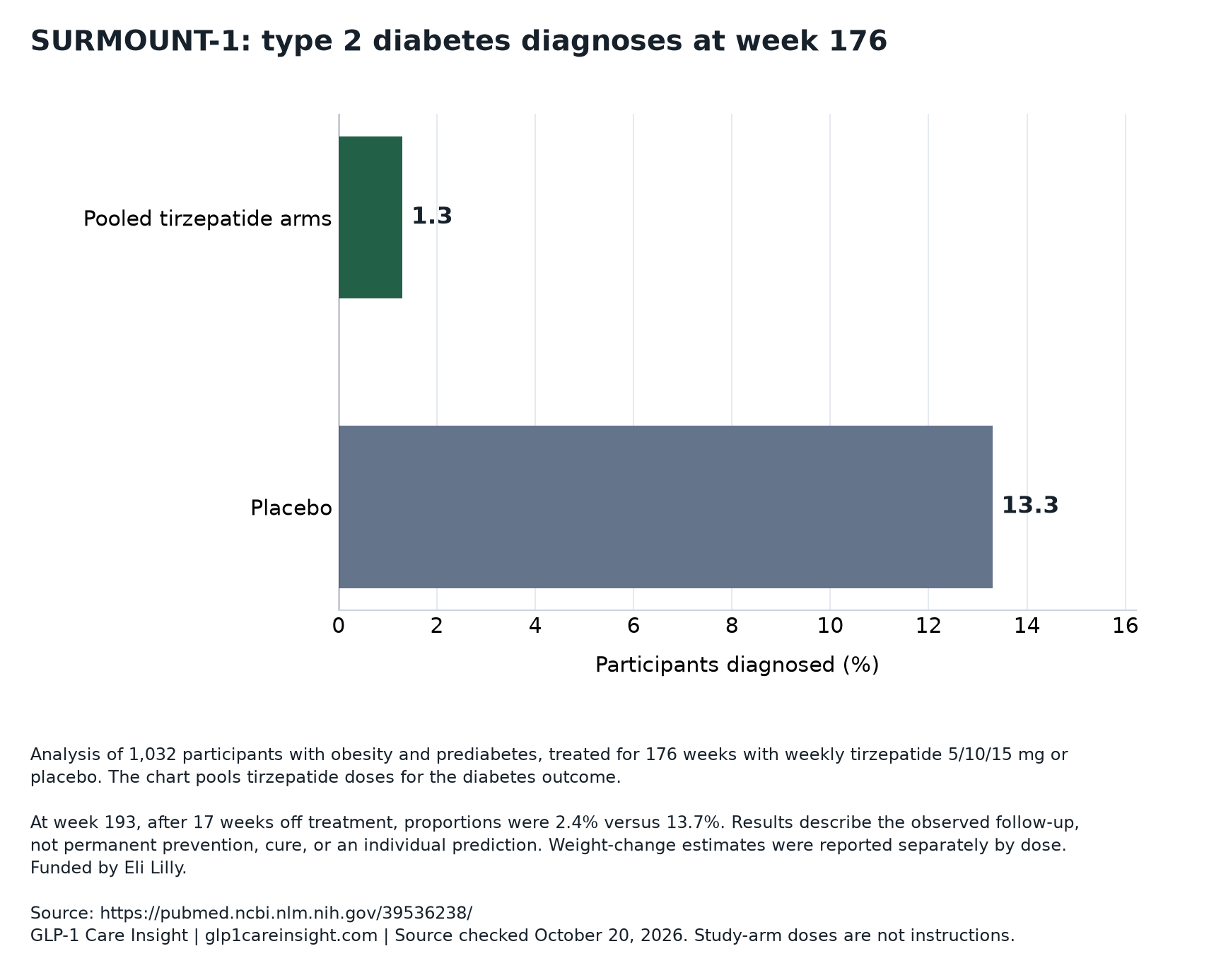
- Type 2 diabetes was diagnosed in 1.3% of the pooled tirzepatide groups versus 13.3% with placebo through week 176; the hazard ratio was 0.07, with a reported 95% confidence interval of 0.0–0.1.Sources: [1]
- After treatment ended
- Through week 193, the cumulative diabetes proportions were 2.4% versus 13.7%; the hazard ratio was 0.12, with a 95% confidence interval of 0.1–0.2.Sources: [1]
- Safety context
- Apart from COVID-19, gastrointestinal events were most common in the extended analysis, usually mild to moderate and concentrated during dose escalation; the investigators reported no new safety signals.Sources: [1]
The trial question was narrower than “Can this prevent diabetes?”
SURMOUNT-1 was a phase 3, randomized, double-blind, placebo-controlled trial. Randomization assigned participants to treatment groups, and blinding meant participants and investigators did not know the assignments during blinded treatment. These design features strengthen the comparison by reducing systematic differences in who receives treatment and how outcomes are assessed.
The original trial enrolled 2,539 adults without diabetes. Eligibility included a body-mass index, or BMI, of at least 30, or at least 27 with a weight-related complication. The extended report focused on 1,032 participants described as having both obesity and prediabetes. It therefore addresses progression from an already elevated-risk state, not prevention across everyone without diabetes.
The distinction matters for applicability. Someone with normal glucose measurements, someone with established diabetes, and someone with prediabetes do not begin at the same point. The study does not supply a personal forecast for any of them. It provides a randomized comparison in a defined research population, with Eli Lilly funding the trial.
What happened over the 176 treatment weeks
Participants were assigned in a 1:1:1:1 ratio to tirzepatide at 5 mg, 10 mg, or 15 mg, or placebo. Tirzepatide was administered once weekly by subcutaneous injection, meaning under the skin. These doses identify research arms, not instructions for starting, changing, or maintaining treatment. The original study included a 20-week dose-escalation period.
In the extended prediabetes analysis, assigned treatment continued for 176 weeks—approximately three years and four months—followed by 17 weeks off treatment. The report identified three key secondary endpoints: percentage weight change at week 176, diabetes onset through week 176, and diabetes onset through week 193. These were not the original trial’s coprimary weight endpoints.
The three extended endpoints were controlled for type I error, the statistical risk of declaring an effect when none exists. That strengthens their interpretation compared with an unplanned search through many outcomes. However, the abstract does not provide the full diagnostic confirmation procedures, missing-data details, or long-term treatment-adherence patterns needed to independently reconstruct the analysis.
STUDY DATA · GLP-1 Care Insight
SURMOUNT-1: type 2 diabetes diagnoses at week 176
Analysis of 1,032 participants with obesity and prediabetes, treated for 176 weeks with weekly tirzepatide 5/10/15 mg or placebo. The chart pools tirzepatide doses for the diabetes outcome.
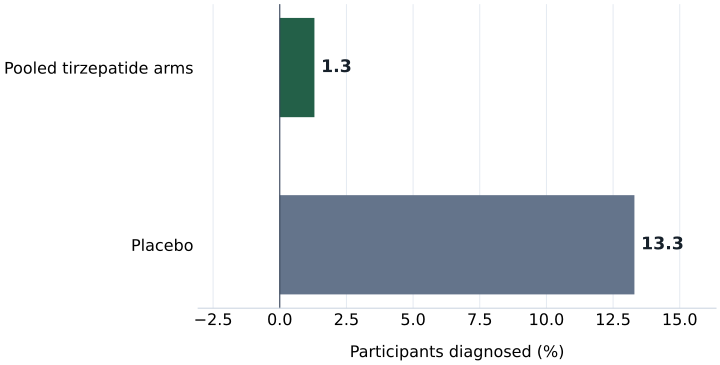
| Study group | Participants diagnosed (%) |
|---|---|
| Pooled tirzepatide arms | 1.3 |
| Placebo | 13.3 |
At week 193, after 17 weeks off treatment, proportions were 2.4% versus 13.7%. Results describe the observed follow-up, not permanent prevention, cure, or an individual prediction. Weight-change estimates were reported separately by dose. Funded by Eli Lilly.
Original visualization of published aggregate data. No individual prediction or provider performance is represented. Original research ↗
The diabetes difference in absolute and relative terms
Through week 176, diabetes was diagnosed in 1.3% of participants in the combined tirzepatide groups and 13.3% in the placebo group. Subtracting those reported percentages gives a 12.0-percentage-point absolute difference. Expressed on a common scale, that is approximately 13 versus 133 diagnoses per 1,000 participants over the reported period—not a prediction of precisely what would happen in another group of 1,000 people.
The hazard ratio was 0.07. A hazard ratio compares the rate at which events occur over follow-up among participants who have not yet experienced the event. It is not identical to dividing the final percentages, because timing matters. Calling this a 93% lower hazard is mathematically appropriate; calling it a 93-percentage-point reduction is not.
The reported 95% confidence interval was 0.0–0.1. Confidence intervals express statistical uncertainty around an estimate. The displayed zero is a rounded boundary, not evidence that the true hazard could literally be absent. For a practical framework on checking denominators, time periods, and comparators, see questions to ask about an advertised study percentage.
| Measure | Through week 176 | Through week 193 |
|---|---|---|
| Treatment context | 176 weeks of assigned treatment | 176 treatment weeks plus 17 off-treatment weeks |
| Diabetes: pooled tirzepatide vs. placebo | 1.3% vs. 13.3% | 2.4% vs. 13.7% |
| Absolute difference, calculated from reported percentages | 12.0 percentage points | 11.3 percentage points |
| Hazard ratio and reported 95% CI | 0.07; 0.0–0.1 | 0.12; 0.1–0.2 |
Why the off-treatment result is encouraging but incomplete
After the additional 17 weeks without assigned treatment, cumulative diabetes proportions were 2.4% in the former tirzepatide groups and 13.7% in the former placebo group. The hazard ratio through week 193 was 0.12. This preserves evidence of a substantial difference across the total observation period, including the short interval after treatment ended.
These are cumulative figures, not diabetes rates confined to the final 17 weeks. Likewise, the week-193 hazard ratio is not a stand-alone estimate of the effect of withdrawal. Subtracting the percentages shows that cumulative diagnoses increased by 1.1 percentage points in the tirzepatide groups and 0.4 points in placebo, but those differences alone do not establish a withdrawal-specific hazard or mechanism.
Interpretation: the follow-up supports delay during the measured period, not cure or lifelong immunity. It cannot show whether the groups would converge, remain separated, or diverge over several untreated years. Readers comparing withdrawal evidence can also consult SURMOUNT-4 and randomized withdrawal, while keeping that separate study’s population and endpoints distinct.
Weight results identify dose arms; diabetes results pool them
At week 176, average weight changes were −12.3% with 5 mg, −18.7% with 10 mg, and −19.7% with 15 mg, compared with −1.3% with placebo. These are mean percentage changes from each participant’s baseline weight, not the percentage of people who lost weight and not changes in BMI units. A group average also does not describe the full spread of individual responses.
By contrast, the headline diabetes result combines the three tirzepatide dose groups. The abstract does not provide a separate diabetes estimate for each dose. It would therefore be incorrect to attach the pooled 1.3% diabetes proportion to the 15-mg arm alone, or to conclude that the larger average weight reduction at higher doses proves greater diabetes prevention.
The study also does not isolate how much of the diabetes difference resulted from weight reduction versus other treatment effects. Randomization estimates the effect of assignment to the treatment strategy; it does not, by itself, separate biological pathways. A relationship between weight and diabetes does not convert these parallel findings into a measured mechanism.
| Study group | Mean weight change | Diabetes reporting in the abstract |
|---|---|---|
| Tirzepatide 5 mg | −12.3% | Included in pooled tirzepatide estimate |
| Tirzepatide 10 mg | −18.7% | Included in pooled tirzepatide estimate |
| Tirzepatide 15 mg | −19.7% | Included in pooled tirzepatide estimate |
| Placebo | −1.3% | 13.3%, compared with 1.3% pooled tirzepatide |
Why the original SURMOUNT-1 weight percentages differ
The original 72-week report found mean weight changes of −15.0%, −19.5%, and −20.9% across the three tirzepatide arms, versus −3.1% with placebo. Its coprimary endpoints were percentage weight change and the proportion achieving at least 5% weight reduction. Those findings came from the broader trial population, not solely the extended prediabetes group.
For context, the original estimates had 95% confidence intervals of −15.9 to −14.2 for 5 mg, −20.4 to −18.5 for 10 mg, −21.8 to −19.9 for 15 mg, and −4.3 to −1.9 for placebo. The extended abstract reports the later weight means without corresponding confidence intervals. The two reports therefore provide different levels of numerical detail.
Comparing the 72-week and 176-week averages does not establish how much the same individuals regained. Population selection, observation time, and analysis methods must be aligned before making that claim. The earlier report explicitly described a treatment-regimen analysis regardless of discontinuation; the extended abstract does not supply equivalent detail. SURMOUNT-1 body-composition evidence addresses another distinct measurement question, not the diabetes endpoint.
Safety findings include tolerability, not just new signals
In the extended analysis, gastrointestinal adverse events were the most common events apart from COVID-19. Most were mild to moderate and occurred mainly during the first 20 weeks, when doses were being escalated. The authors reported no new safety signals over three years. That wording means no newly identified pattern of concern, not that adverse effects were absent.
The original 72-week report supplies a concrete tolerability measure: adverse events caused treatment discontinuation in 4.3%, 7.1%, and 6.2% of the 5-mg, 10-mg, and 15-mg groups, respectively, versus 2.6% with placebo. These figures belong to the original broader population and follow-up. They should not be relabeled as three-year discontinuation rates in the prediabetes subgroup.
The extended abstract does not provide a detailed adverse-event table, so it cannot support precise claims about uncommon events or every category of serious harm. For discussion purposes, useful questions include which symptoms require assessment, how adverse effects are followed, and what happens if treatment becomes intolerable. A topic-organized consultation guide can help keep those questions separate from expectations about benefit.
A maintenance trial cannot fill the diabetes follow-up gap
SURMOUNT-MAINTAIN asked a different question: how well weight reduction was maintained after an initial 60-week period of tirzepatide treatment. Of 441 participants entering that initial phase, 378 were randomized to continue their maximum tolerated 10-mg or 15-mg dose, reduce to 5 mg, or switch to placebo for another 52 weeks. This selected population had already reached the maintenance stage.
At week 112, model-based weight changes from the original baseline were −21.9% with continued maximum tolerated dosing, −16.6% with 5 mg, and −9.9% with placebo. Their respective 95% confidence intervals were −23.5 to −20.3, −18.0 to −15.1, and −11.1 to −8.8. These weight findings do not establish diabetes-prevention effects for reduced-dose treatment.
Rescue tirzepatide could begin 24 weeks after randomization if participants regained more than half their lost weight. The primary analysis explicitly accounted for rescue using a specified assumption about further benefit from assigned treatment. That design is not equivalent to SURMOUNT-1’s 17-week off-treatment observation. Both trials were Lilly-funded; neither supplies years of untreated diabetes follow-up after successful prevention.
What remains unknown about an individual’s future risk
Prediabetes identifies glucose regulation that is abnormal but not yet classified as diabetes. Within that category, people can differ in baseline measurements, health history, and subsequent course. The abstract reports an overall comparison; it does not provide enough subgroup detail to calculate a personalized diabetes probability or determine whose benefit would be largest.
Diagnosis is also different from every outcome a patient might value. The extended abstract does not establish reductions in cardiovascular events, kidney failure, mortality, or diabetes complications. Delaying diagnosis could matter clinically, but these particular results cannot quantify those downstream outcomes or prove that every measure of health improved.
The most useful uncertainty questions are therefore specific: How was diabetes confirmed? How complete was follow-up? What happened to participants who discontinued? Did effects vary across baseline glucose levels? The indexed abstract does not settle these issues. Its lack of detail should not be mistaken either for a demonstrated flaw or for proof that every analytical concern was resolved.
Translating evidence into care and contract questions
NIDDK describes medication decisions as depending on health history, other medicines, benefits, adverse effects, and cost. Duration depends on benefit and tolerability, and weight regain can occur after stopping. The prevention report is not current prescribing information and does not establish an approved indication, personal eligibility, or insurance coverage for preventing diabetes.
Interpretation: a multiyear clinical result makes continuity worth discussing, but it does not validate a particular subscription or provider. Coverage questions can separate insurance terms from trial evidence. A documentary review such as the Ro Body review can help identify terms to verify before enrollment; it does not establish that the provider offers the studied product, prevention care, or comparable outcomes.
Product identity is another boundary. FDA states that compounded drugs are not FDA approved or reviewed before marketing for safety, effectiveness, or quality, and recommends them only when a patient’s needs cannot be met by an approved drug. SURMOUNT-1 results cannot automatically transfer to compounded preparations, oral routes, other formulations, or a provider’s service. Reported compounding problems also do not, by themselves, establish event rates or causation.
Questions & answers
Does the study mean tirzepatide cures prediabetes?
No. It demonstrated substantially less progression to diagnosed type 2 diabetes during a defined observation period. A cure would imply a durable resolution that these results do not establish. The extended abstract also does not provide the information needed to equate avoiding a diabetes diagnosis with sustained normalization of every glucose measurement.
Why are 1.3% and 2.4% both reported for tirzepatide?
They describe different cumulative follow-up windows. The 1.3% figure covers 176 weeks of assigned treatment; 2.4% covers those weeks plus 17 off treatment. The latter is not the percentage newly diagnosed only after stopping. Both estimates pool the three tirzepatide arms.
Can the 5-mg group be assumed to have the same diabetes benefit as the higher-dose groups?
Not from the abstract. Weight changes are reported separately by dose, but the diabetes estimate combines the tirzepatide groups. Pooling improves the overall comparison’s information base while leaving dose-specific diabetes effects unresolved in this accessible report. The maintenance trial’s 5-mg weight result does not answer that prevention question.
Does the remaining benefit after 17 weeks mean treatment can be stopped without losing protection?
No. A cumulative difference can remain because many diagnoses were avoided or delayed earlier, even if future risk changes after withdrawal. Seventeen weeks is too short to establish durable untreated protection. The finding informs a scientific question about persistence; it does not provide an individual stopping or tapering plan.
What should someone ask when a program advertises this prevention result?
Ask which population, endpoint, follow-up period, and formulation the claim refers to. Then separate those answers from medication identity, monitoring, coverage, and cancellation terms. The randomized trial evaluated treatment under research conditions, not a commercial program’s performance. Its findings do not establish equivalence for compounded products or guarantee an individual outcome.
Our assessment
SURMOUNT-1 provides strong randomized evidence that tirzepatide substantially delayed progression to type 2 diabetes over approximately three years in participants with obesity and prediabetes. The absolute difference was large within this trial, and a cumulative difference remained after a short off-treatment interval. The clearest interpretation is prevention or delay within observed follow-up—not permanent protection. Dose-specific diabetes effects, longer untreated durability, individual risk prediction, and downstream complications remain separate questions. Keeping those distinctions intact makes the result more useful, not less impressive.
Sources & documentation
Scientific and official sources consulted October 20, 2026. Study findings apply to the populations, products and time periods described; they are not provider outcome data.
- Tirzepatide for Obesity Treatment and Diabetes Prevention. ↗
- Tirzepatide Once Weekly for the Treatment of Obesity. ↗
- Tirzepatide for maintenance of bodyweight reduction in people with obesity in the USA (SURMOUNT-MAINTAIN): a multicentre, double-blind, randomised, placebo-controlled trial. ↗
- NIDDK prescription medications for overweight and obesity ↗
- FDA concerns about unapproved GLP-1 drugs ↗